Technical planning and partner coordination
Software engineering for EU-funded projects.
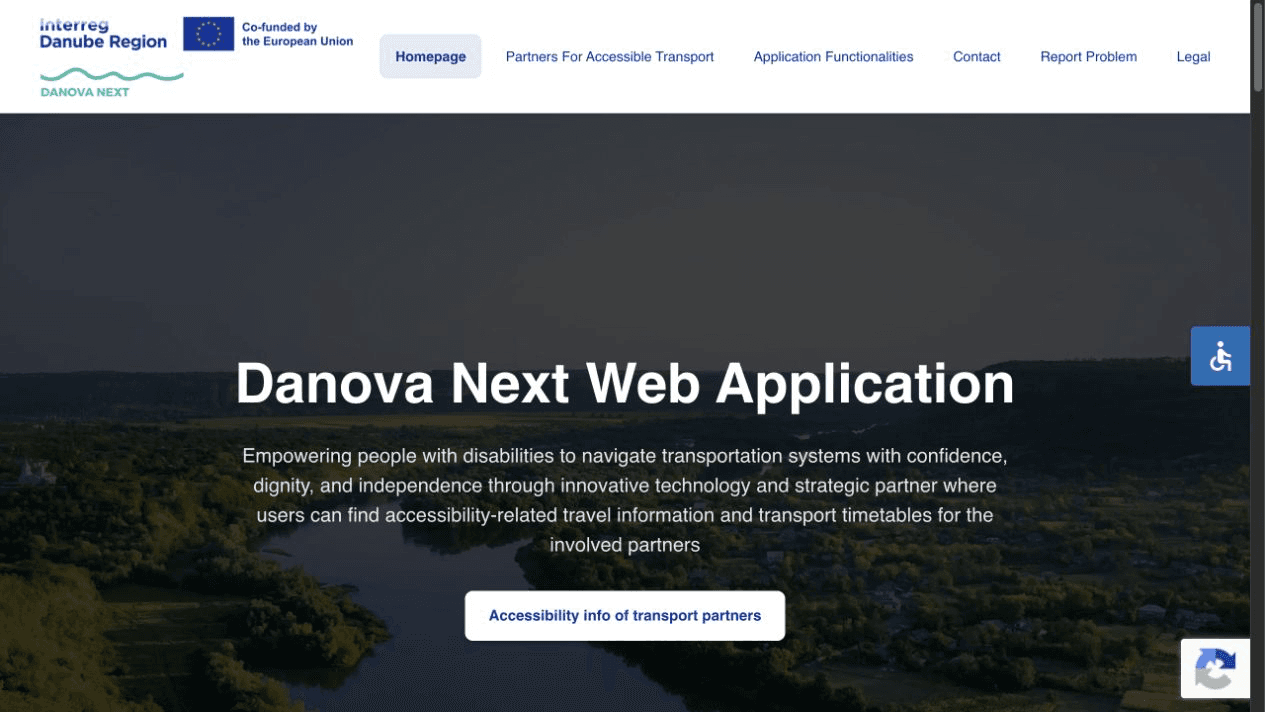
We develop accessible web applications and coordinate technical delivery across international consortia. Our experience includes the DANOVA NEXT web application, developed for an Interreg Danube Region project co-funded by the European Union.
Delivery standards and practices
- WCAG 2.2 AA
Accessibility target
- Privacy by design
GDPR principles
- Partner interoperability
Shared APIs and data contracts
- Delivery traceability
Documented decisions, testing, and handover
We define accessibility and data-protection requirements for each project. Conformance is assessed through testing and review of individual deliverables.
Interreg delivery experience
DANOVA NEXT: accessible travel information.
DANOVA NEXT aims to improve air, water, and urban transport accessibility for passengers with disabilities and reduced mobility across the Danube Region. Its objectives cover shared accessibility data, a regional strategy, local pilots, and guidance for replicating the solutions.
Led by Dubrovnik Airport, the consortium brings together transport operators, research institutions, and disability organisations.
Our technical contribution. We developed the project's accessible web application, bringing partner information into a shared service for travellers. Our contribution covers application development and technical coordination with partner teams.
- Programme
- Interreg Danube Region 2021-2027
- Consortium
- 11 countries, 16 partners, and 2 associated partners
- Focus
- Smart Transport Network and digital travel information services
- Project ID
- DRP0200298
- Project period
- 1 January 2024 to 30 June 2026
- Total project budget
- EUR 2,622,400, with 80% Interreg funding
Figures published by Interreg Danube Region. The budget covers the entire project, not the software development contract.
The DANOVA NEXT consortium.
Partner organisations contribute transport, accessibility, and research expertise. Our role within the project concerns the web application and technical coordination.
Airports


Urban transport and mobility

Accessibility organisations
Research and innovation

Associated partners
- Ombudsman for Persons with DisabilitiesCroatia
- Ministry of Transport and Maritime AffairsMontenegro
Organisation names follow the official project sources. Associated partners are listed separately from the 16 consortium partners.
Documented partner input in Bratislava.
- Application feedback
- ANSR and SOIH presented feedback from users and specialists.
- Evaluation and testing
- WU Vienna covered evaluation, DPB introduced the pilot-testing appraisal template, and the University of Maribor addressed impact and transferability.
Technical delivery across the consortium.
We translate project objectives into an agreed technical scope, with milestones and responsibilities for each partner. Requirements, decisions, and acceptance criteria remain documented throughout delivery.
- 01
Define the technical scope
We translate project objectives into requirements and system architecture, with delivery milestones and accessibility criteria agreed from the outset.
- 02
Coordinate partner contributions
We agree data responsibilities, integration requirements, and approval procedures with partner teams. Online working sessions and documented decisions keep dependencies visible.
- 03
Develop and integrate
We build the application and connect partner systems through documented APIs and validated data flows. Permissions and exception handling form part of the implementation.
- 04
Validate and hand over
We test agreed scenarios with partners and users, document the delivered system, and prepare the teams who will operate it. Maintenance responsibilities are defined before handover.
Accessible software and connected systems.
Our DANOVA NEXT work combines accessible application development with partner data integration. For projects that require automation or AI, we define where fixed rules apply and where human oversight is necessary.
- Accessible web applications
- We build semantic interfaces with keyboard navigation and readable contrast. Assistive technology support, multilingual content, and responsive layouts are part of the design and validation process.
- Partner data integration
- We connect partner data through documented APIs and shared data models. Validation rules preserve the source, ownership, and consistency of information.
- Connected smart systems
- We combine web applications, rule-based automation, and integrations to support shared operational processes. System status, errors, and responsibilities remain visible to the teams involved.
- Agentic AI solutions
- We integrate AI for classification, extraction, and research where the project requires it. Explicit permissions, human approval, and action logs define how agents operate within the workflow.
Technical coordination, online and in person.
We lead technical working sessions with project coordinators, specialists, and data owners to resolve dependencies and agree implementation decisions. Our DANOVA NEXT involvement included in-person discussions with project partners in Bucharest and Bratislava.
Under WPT2, Activity 2.3, Matei Oprea presented the application's design and technical progress on behalf of Dubrovnik Airport. Partners discussed development priorities and technical challenges.
Read the official meeting reportTechnical expertise for your consortium.
We can support lead partners, work package coordinators, public authorities, universities, NGOs, and operational teams. Our role can begin with technical planning or focus on an existing work package that requires software development and integration.
Define the technical scope of your project.
Start with a workflow, the organisations involved, and the systems it depends on. We identify the technical requirements and integration responsibilities, then outline a delivery approach for your work package.