01
Custom web apps
Focused internal tools, client portals, and operations hubs shaped around how your team actually works.
One place to see state, act on work, and manage exceptions.Remote delivery for UK SME owners and operational leaders
We map work trapped across spreadsheets, email, CRM, finance tools and legacy systems, then deliver bounded automation, integrations and operational software through a clear UK package.
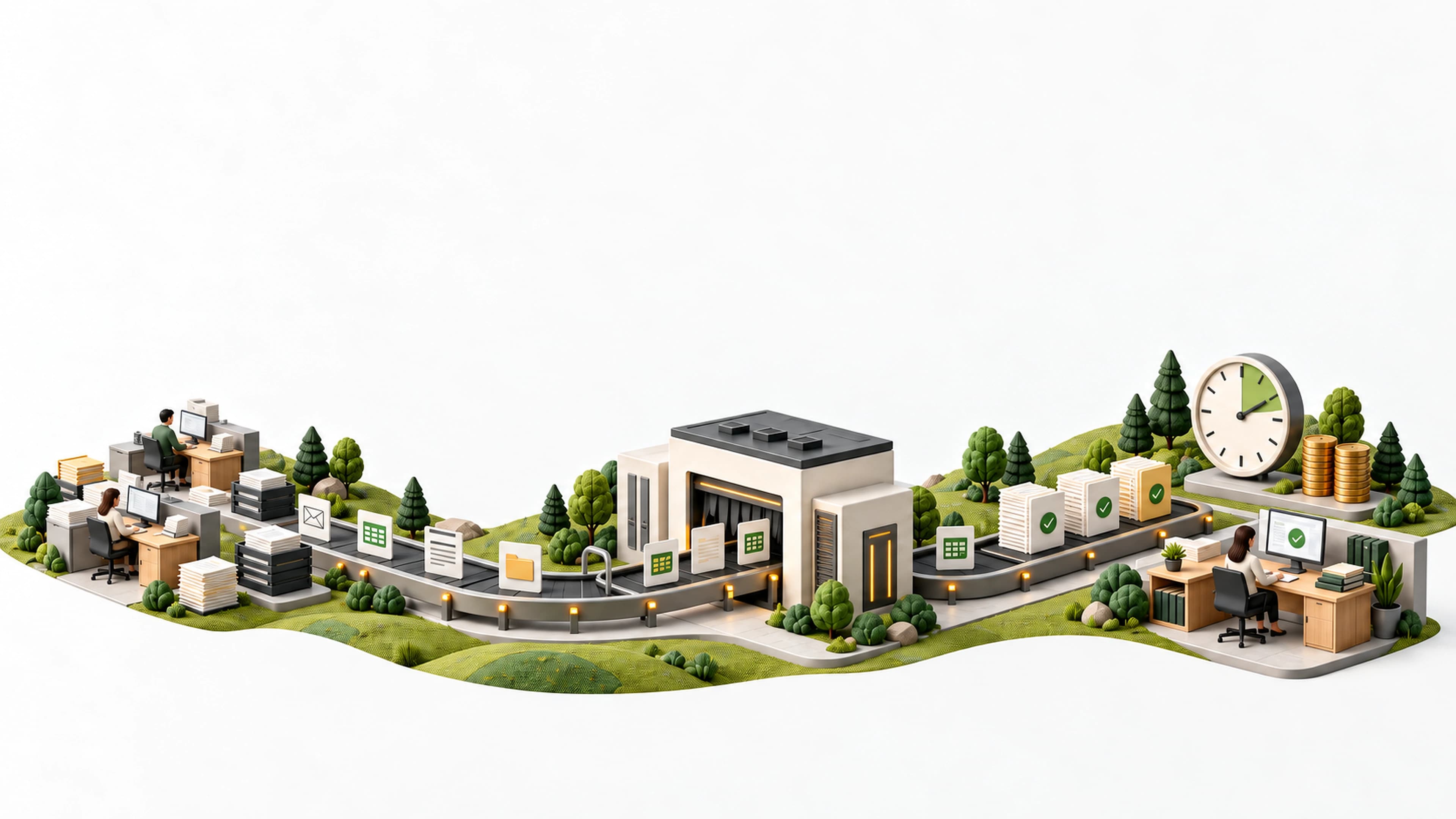
Built around your operation, not a preferred vendor stack.
Every implementation follows the same control points. The scope changes; the discipline does not.
Discovery
System design
Implementation
Validation
Rollout
Operational architecture
Inputs, exact rules, bounded AI work, human review, and system updates remain separate enough to inspect and control.
Solutions
The right answer may be a connection, an automation, a focused application, or a diagnosis before anything is built. Each path starts with the real workflow.
Explore all solutionsConnect systems and remove repeatable handoffs with explicit validation, routing, logging, and recovery.
02Use AI for narrow interpretation tasks while deterministic rules and people retain consequential authority.
03Give teams one useful place to see state, act on work, approve decisions, and manage exceptions.
04Decide what to keep, buy, connect, automate, or build before technology turns uncertainty into cost.
Not an AI demo and not a pile of disconnected tools. We combine software, exact automation, and bounded judgment where each belongs.
Focused internal tools, client portals, and operations hubs shaped around how your team actually works.
One place to see state, act on work, and manage exceptions.Reliable rules for repetitive work: validate, route, transform, notify, reconcile, and record.
Predictable behaviour where the answer should never be a guess.AI for classification, extraction, drafting, and research inside explicit permissions and approval gates.
Judgment where it helps, guardrails wherever it can fail.Cases and solution blueprints
The library combines published work, anonymised implementations, research projects, and representative designs. Each card states its status so a concept is never presented as a UK client result.
View all cases and blueprintsPublished case study — attributed implementation
An integrated operations layer connecting customer records, consultations, room data, proposals, signatures, deposit invoices, and timed follow-up for a bespoke wardrobe manufacturer.
Operations app + four connected workflow systems
Published case study — attributed implementation
A multilingual web application that brings accessibility information from airports, ports, and public-transport partners into one structured, inclusive experience for travellers with disabilities.
Accessible web application + shared partner data model
Published case study — attributed implementation
Two distinct websites built for different jobs: an online store for Power of God and an agency website for Pedu Media, each with its own visual identity, navigation and conversion path.
Two public websites with independent design and functionality
Published case study — attributed implementation
A proprietary agentic platform that gives AI agents company context, structured work, recurring schedules, connected tools and deployable sub-applications inside one operating environment.
Proprietary agent platform + six operational product surfaces
Published case study — attributed implementation
A SaaS application that lets web agents turn conversation context into shareable Markdown, HTML or JSX pages while users control publication, updates and reuse.
SaaS application + agent publishing interface + versioned web pages
Delivered engagement — identifying details removed
An integrated WhatsApp, AI agent and custom CRM system that handles personalized wall-art order conversations in parallel, keeps order status visible and hands complex cases to the team with their context intact.
WhatsApp agent + custom order CRM + escalation interface
Solution blueprint — not a client result
A controlled intake system that captures enquiries, checks required data, researches the account, and routes a review-ready opportunity to the right owner.
Workflow map + routing specification
Solution blueprint — not a client result
A focused web application that connects signed work, delivery milestones, client requests, internal ownership, and exception handling in one operational view.
Web app + automation blueprint
Solution blueprint — not a client result
A traceable queue that receives requests and documents, validates their contents, proposes a route, and keeps ambiguous or sensitive cases with the right human owner.
AI boundary + exception design
A system, not a shortcut
Each layer has one job. Data can be checked before it reaches AI, uncertain work can pause for a person, and every action can leave a useful record.
What gets delivered
Current state, target state, actors, systems, triggers, and handoffs.
Normal paths, edge cases, missing information, duplicates, and failures.
Exact logic, AI scope, confidence thresholds, permissions, and approvals.
The agreed app, automations, integrations, and operator surfaces.
Checks tied to your real scenarios before staged rollout.
Documentation, accounts, responsibilities, monitoring, and change guidance.
A six-step path from one operational bottleneck to a system people can trust and own.
We start with a real process, the people inside it, and the tools it crosses—not a predetermined automation package.
We document triggers, data, decisions, handoffs, exceptions, and the actual cost of the current flow.
Together we decide what should be deterministic, where AI is appropriate, and where a person must stay in control.
We connect systems and ship the smallest complete path first, so your team can react to working software early.
Your scenarios become acceptance tests, including missing data, duplicate requests, integration outages, and low-confidence AI outputs.
We release with monitoring, operator guidance, and clear ownership, then evolve the system as the workflow changes.
After launch
For systems we deliver, ongoing work can cover agreed maintenance, monitoring, incident handling, and a regular review. Coverage, response expectations, hosting, accounts, and costs belong in the written agreement. New development is scoped separately.
Tools and decision aids
Use a free diagnostic when the problem is still forming, inspect evidence when you need confidence, and request a consultation when a real workflow is ready for review.
Answer three bounded questions and receive a preliminary system direction without sharing confidential information.
Work through practical maps, checklists, and decision tables for spreadsheet-dependent operations.
Read the guidesInspect delivered, published, anonymised, research, and concept work with the evidence boundary visible.
Inspect the casesCompare the £3,500 diagnostic, £15,000 automation sprint, £35,000 app foundation and £2,000/month care plan, including their written boundaries.
View packages and pricingNot every problem needs custom software. AutomateFlow is a fit when the work crosses tools, carries exceptions, and needs clear operational ownership.
Swipe or scroll to compare the columns.
| What the workflow needs | AutomateFlow | Off-the-shelf tool | Ad hoc script |
|---|---|---|---|
| Fits a cross-tool operational flow | Yes: Designed around it | Partial: Only within product limits | Partial: Possible, but fragmented |
| Rules and AI responsibilities are explicit | Yes: Included in the design | Partial: Varies by vendor | No: Rarely documented |
| Human approvals and exception paths | Yes: Built into the flow | Partial: Configuration dependent | No: Usually manual |
| Interface shaped for your team | Yes: Custom where needed | No: Standard interface | No: No shared interface |
| Ownership, logs, and handover | Yes: Delivered with the system | Partial: Vendor dependent | No: Depends on its author |
A standard tool is often the better answer for a standard process. We will say so when mapping the workflow points there.
The practical questions teams ask before putting software and AI inside an operational flow.
Ask us directlyUsually not. We first map the systems already carrying the workflow and connect them where their APIs and permissions allow. A custom app is introduced only when your team needs a clearer place to operate the process.
Initial consultation
We collect only the details needed to assess the request and reply to you.